
Wood Borers
Order: Coleoptera
Wood borer beetles are a group of insects whose larvae feed on wood and bamboo, causing damage that is often extensive before it becomes visible. Unlike termites, they don’t live in colonies — each larva develops alone inside the timber it hatched in, which is part of why an infestation can go unnoticed for so long.
Several unrelated beetle families cause this kind of damage, but in India, powderpost beetles (family Bostrichidae, which now includes the group formerly classified as Lyctidae) are the most commonly encountered in homes, furniture and bamboo structures.
Scientific Classification
- Kingdom: Animalia
- Phylum: Arthropoda
- Class: Insecta
- Order: Coleoptera
- Family: Bostrichidae
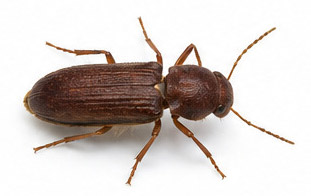
Common Household Species in India
Powderpost Beetle — Scientific Name: Lyctus africanus — Size: 2–7 mm
False Powderpost Beetle — Family: Bostrichidae (broader group)
Commonly found in tropical hardwoods and bamboo.
Other Species:
- Longhorn Beetles (Cerambycidae)
- Deathwatch and Furniture Beetles (Ptinidae)
Coleoptera is the largest order of insects on Earth, and wood-boring species are found across several of its families.
Biology
Body Structure
Wood borer beetles have a hard, cylindrical or flattened body, short antennae and strong chewing mouthparts adapted for boring into timber. Larvae are soft, pale and C-shaped, spending almost their entire lives hidden inside the wood they feed on.
Life Cycle
Wood borers undergo complete metamorphosis. Females lay eggs in cracks, pores or joints in unfinished wood. The larvae then bore inward, feeding for an extended period before pupating close to the surface and emerging as adults.
Reproduction: Eggs are laid on or just below the surface of seasoned wood or bamboo, often in existing cracks or pores.
Growth & Lifespan: The larval stage is by far the longest part of the life cycle, ranging from several months to a few years depending on the species, wood type and moisture content. Adults, by contrast, live only a matter of weeks.
Behaviour: Larvae remain hidden inside the wood throughout their development. Adults are short-lived, mate soon after emerging, and are often drawn to light — commonly found on windowsills after emergence.
Habitat: Seasoned hardwood furniture, structural timber, flooring, door and window frames, and bamboo articles.
Diet: Larvae feed on the starch content within wood and bamboo, particularly sapwood.
Why Are They Found in Homes?
Wood borers are often already present, as eggs or young larvae, inside wood or bamboo items before they even enter a home — furniture, flooring or décor can carry an infestation from the point of manufacture. Once inside, warm indoor conditions and untreated wood surfaces allow development to continue undisturbed.
Why They Are a Concern
Because larvae feed from within, significant structural weakening can occur before any exit holes or damage become visible on the surface. Furniture, flooring, roof timbers, doors and bamboo structures can all be affected, and repeated infestations over time can meaningfully shorten the working life of wooden items and structural elements alike.
Signs of Activity
Exit Holes: Small, round or oval holes on the wood or bamboo surface, left behind as adults emerge.
Frass: Fine, powdery wood dust found beneath or around infested items.
Weakened Wood: Timber that sounds hollow or feels structurally unsound despite an intact surface.
Adult Beetles: Sightings of small beetles near windows or light sources, particularly during warmer months.
Seasonal Activity
Wood borer beetles remain active year-round as larvae, since they’re sealed inside timber largely insulated from outside conditions — but adult emergence is more seasonal, typically peaking in warmer months when development completes faster.
In Arunachal Pradesh, humidity affects this in a way that’s specific to wood borers rather than the pest itself: sustained moisture raises the internal moisture content of untreated wood and bamboo, which speeds up larval development rather than simply “encouraging activity” the way rainfall does for many other pests. In practice, this means wood and bamboo structures kept in consistently damp conditions — common during the region’s extended monsoon — are more vulnerable to faster-developing infestations than the same materials kept dry.
Interesting
Facts
Wood borer larvae can spend years inside a single piece of timber before ever being seen as adults.
Powderpost beetles get their name from the fine, flour-like powder their larvae leave behind — a texture distinct enough that it can help identify them from other wood-damaging insects.
Bamboo, despite being a grass rather than true wood, is just as vulnerable to powderpost beetles as hardwood, due to its high starch content.
An infested piece of furniture can carry beetles from the workshop it was made in into a home, without the infestation being visible at the time of purchase.
Concerned about wood borer activity in your home or furniture?
See our Wood Borer Treatment Service