
Flies
Order: Diptera
Flies are among the most familiar insects found around homes, restaurants, markets and food establishments. Belonging to the order Diptera, they play an important ecological role by helping decompose organic matter and recycle nutrients. However, certain species become important public health pests when they breed in waste and contaminate food or food-contact surfaces.
This page focuses on the common flies encountered around homes and commercial premises in India, particularly the House Fly, Blow Fly and Fruit Fly.
Common Household Species in India
| Feature | House Fly | Blow Fly | Fruit Fly |
|---|---|---|---|
| Scientific Name | Musca domestica | Family Calliphoridae | Family Tephritidae |
| Common Name | House Fly | Blow Fly / Bluebottle / Greenbottle | Fruit Fly |
| Commonly Associated With | Homes, Kitchens, Restaurants, Garbage, Animal waste | Decaying meat, Animal carcasses, Organic waste | Overripe fruits, Fermenting vegetables, Kitchens, Fruit shops |
Scientific Classification
- Kingdom: Animalia
- Phylum: Arthropoda
- Class: Insecta
- Order: Diptera
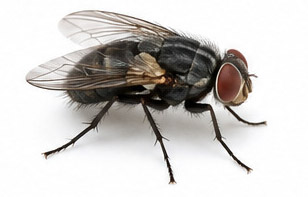
Distinguishing Common Household Flies
| Feature | House Fly | Blow Fly | Fruit Fly |
|---|---|---|---|
| Appearance | Grey with four dark stripes | Metallic blue or green | Small yellow-brown |
| Size | Medium | Large | Very small |
| Common Breeding Site | Garbage, animal waste & decaying organic matter | Decaying meat & animal carcasses | Overripe fruits & fermenting produce |
| Commonly Found | Homes, kitchens & restaurants | Waste areas, slaughterhouses & carcasses | Kitchens, fruit bowls & fruit shops |
| Health Importance | Food contamination and mechanical transmission of microorganisms | Indicates the presence of decaying organic matter or animal remains | Food spoilage and contamination of fruits and vegetables |
The name Diptera means “two wings”, referring to the single functional pair of wings possessed by true flies.
Biology
Body Structure
Flies possess a head, thorax and abdomen, one pair of wings and two specialised balancing organs called halteres. Their large compound eyes provide a wide field of vision, while their sponge-like mouthparts allow them to feed only on liquids.
Life Cycle
Flies undergo complete metamorphosis. The larval stage, commonly known as the maggot, develops in suitable organic material before transforming into the pupal stage and finally emerging as an adult fly.
Reproduction: Females lay eggs on suitable breeding material such as garbage, decaying organic matter or fermenting food.
Growth & Lifespan: Under favourable conditions, many common flies complete their life cycle within one to two weeks.
Behaviour: Adult flies are active during the day and are strongly attracted to food odours, moisture and decomposing organic matter.
Habitat: Flies occur wherever food and breeding material are available.
Diet: Most adult flies feed on liquid or liquefied organic material, sugars and other nutrient-rich substances.
Why Are They Found in Homes?
Flies are attracted to environments that provide food, moisture and suitable breeding sites. Household garbage, pet waste, compost, uncovered food, drains and decaying organic matter create ideal conditions for fly activity.
Natural predators include spiders, dragonflies, birds, frogs and predatory insects. However, abundant food and breeding sources around human settlements allow fly populations to increase rapidly.
Why They Are a Concern
Many common pest flies breed in garbage, animal waste, decaying organic matter and other unsanitary environments. As adult flies move between these breeding sites and human food, they can mechanically transfer bacteria and other microorganisms on their body, legs and mouthparts. Some species also regurgitate digestive fluids and defecate while feeding, increasing the potential for contamination of food and food-contact surfaces.
Signs of Activity
Adult Flies: Frequent fly activity around kitchens, dining areas or waste bins.
Maggots: Creamy white larvae developing in garbage or decaying organic matter.
Pupae: Brown capsule-like pupae found near breeding sites.
Food Contamination: Flies repeatedly landing on exposed food.
Waste Accumulation: Garbage or organic waste attracting large numbers of flies.
Persistent Indoor Activity: Repeated sightings indoors may indicate a nearby breeding source.
Seasonal Activity
Fly activity generally increases during warm weather when breeding conditions are favourable.
In Arunachal Pradesh, waste management is often the bigger factor here than weather alone, particularly in and around more built-up areas. Flies breed directly in organic waste, so wherever garbage collection is inconsistent or waste sits uncollected, breeding conditions can persist well beyond any single season. Warm, humid weather accelerates development once breeding material is available, but it’s the waste itself that determines how much activity there is to begin with.
Interesting
Facts
Why are flies so difficult to swat? Flies have large compound eyes made up of thousands of tiny lenses that provide an almost panoramic field of vision. Combined with specialised balancing organs called halteres, they can detect movement and change direction almost instantly, making them remarkably difficult to catch.
Flies taste with their feet. Tiny sensory receptors on their feet allow them to “taste” a surface the moment they land, helping them determine whether it is suitable for feeding.
House flies cannot chew solid food. Instead, they release saliva onto food to dissolve it into a liquid before sucking it up with their sponge-like mouthparts.
Not all flies are pests. Many fly species are important pollinators and decomposers, helping recycle nutrients and serving as food for birds, bats, spiders and other wildlife.
Concerned about fly activity in your home or business?
See our Fly Management Service